The technology platform behind your EV charging business.
CarChargeOS is the white-label EV charging platform enterprise operators run on - station management, payments and billing, enterprise-grade security, and flexible deployment from cloud to on-premise, built to launch under your brand in weeks.

 AUGUST 2026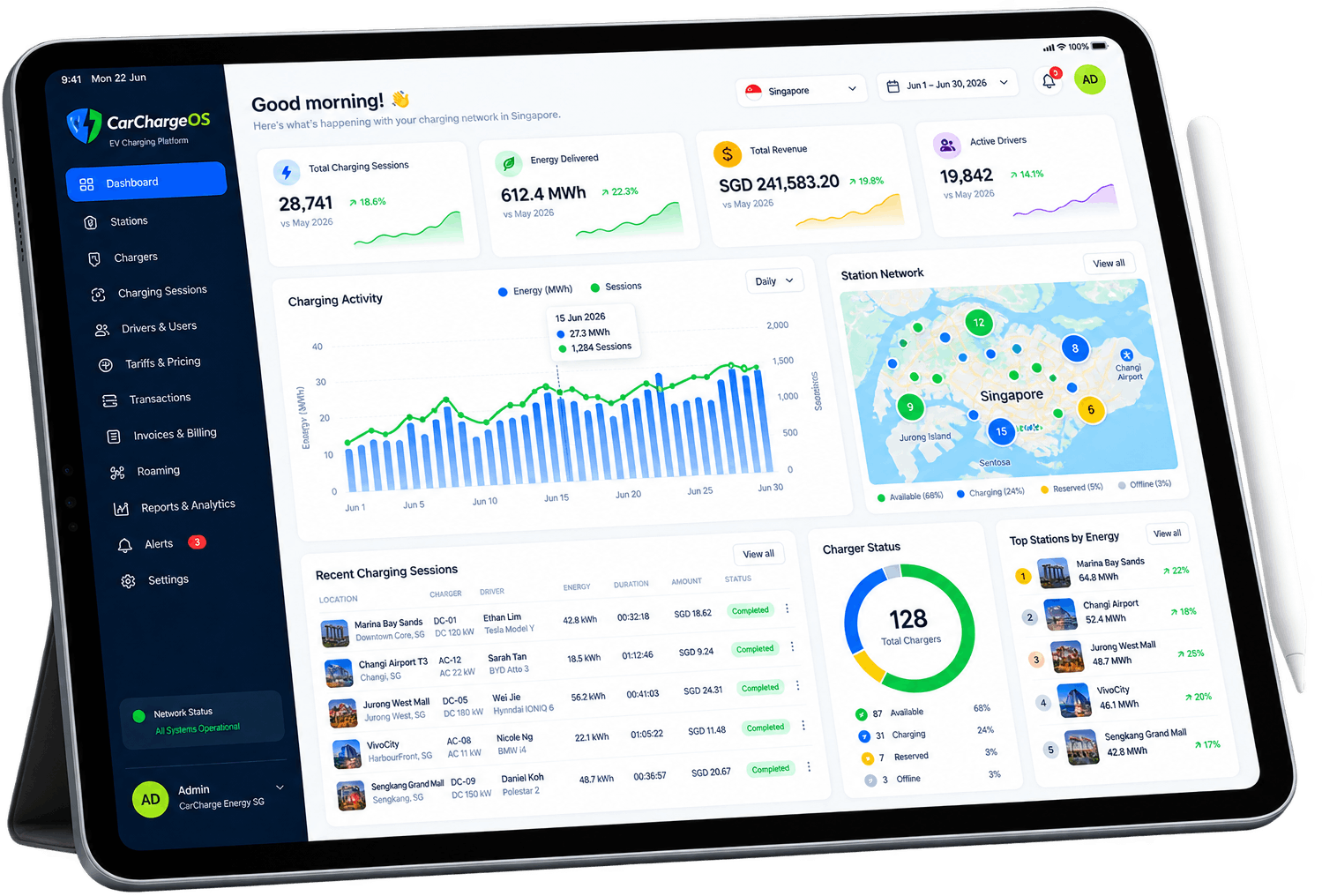
The technology platform behind your EV charging business.
A complete, white-label EV charging platform - branded EV owner apps, operator console, payments, billing, infrastructure and integrations - delivered and operated by CarChargeOS, under your brand.
 CONTENTS
Contents
What CarChargeOS Enterprise delivers, how it deploys, and how a launch unfolds - from platform capabilities to commercial next steps.
01 · EXECUTIVE SUMMARYLaunch your EV charging business. Without building the technology.
Building an EV charging platform requires far more than connecting chargers. It means maintaining mobile applications, payment workflows, billing engines, cloud infrastructure, charger protocols, security and continuous product development - a software organization in its own right.
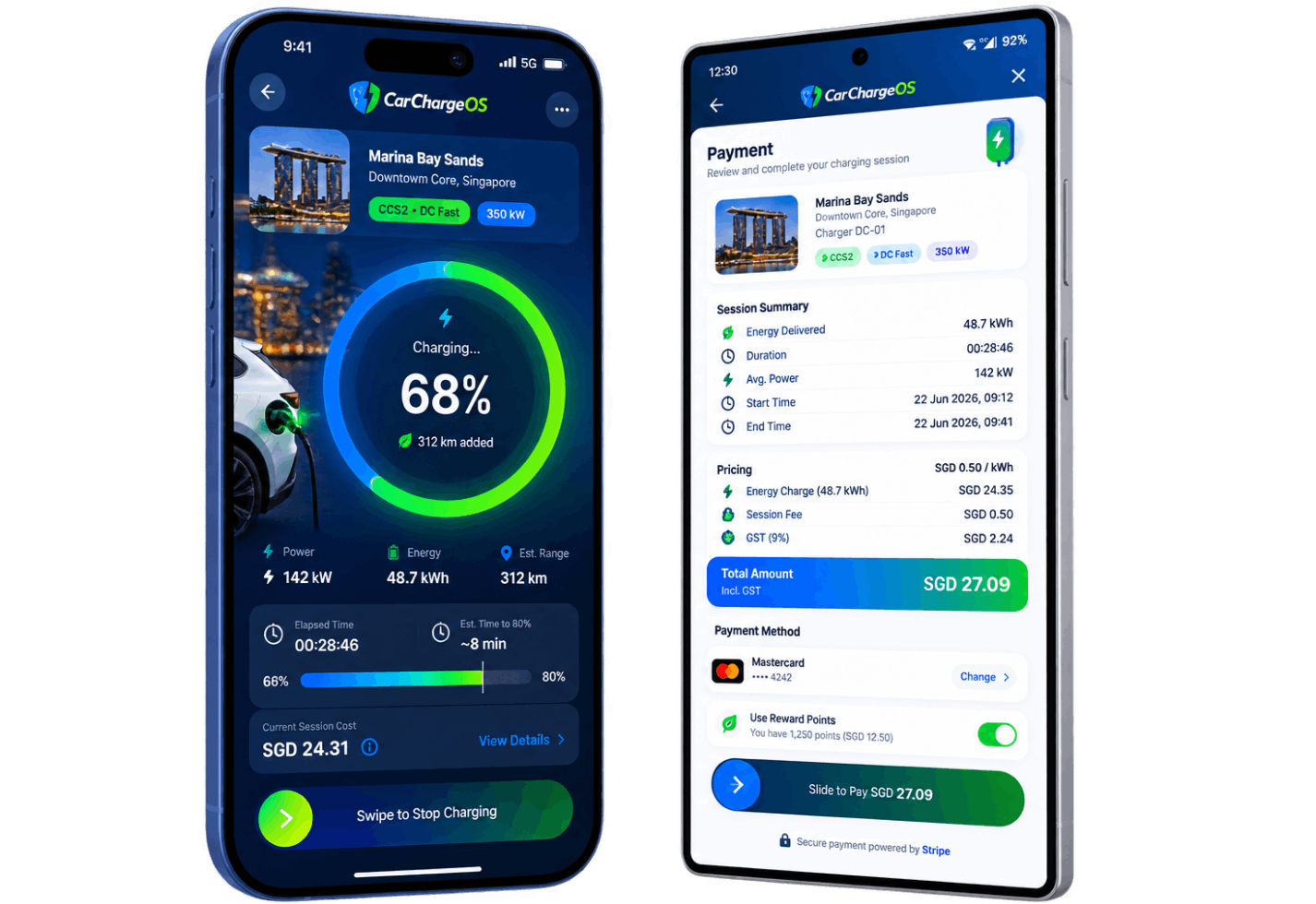
Branded iOS and Android apps for discovering chargers, starting sessions, live monitoring, payments and charging history.
A branded management platform for stations, chargers, customers, sessions, tariffs, billing, reporting and operations.
CarChargeOS Cloud, your own public cloud account, or an on-premise deployment - matched to your security and data-residency requirements.
Payment providers, identity systems, ERP, CRM, roaming partners and business systems connected through APIs and industry standards.
02 · WHAT ENTERPRISE CLIENTS EXPECTTen requirements that decide enterprise platform selections.
Enterprise EV charging programmes are evaluated on more than features. This is how CarChargeOS addresses the criteria that decide tenders and RFPs.
| REQUIREMENT | HOW CARCHARGEOS DELIVERS | |
|---|---|---|
| 01 | Brand & customer ownership | Fully white-label. Apps published under your developer account; customers and their data belong to you, exportable at any time. |
| 02 | Security & compliance | Encryption in transit and at rest, role-based access, enterprise identity and request-level audit logging, aligned with ISO 27001. |
| 03 | Data residency & control | Managed cloud with in-country residency, deployment into your own cloud account, or fully on-premise - same product, same releases. |
| 04 | Vendor independence | Hardware-agnostic: any OCPP-compliant charger, AC to ultra-fast DC, from any manufacturer. Open standards prevent lock-in. |
| 05 | Time to market | Structured implementation targeting go-live in 4–6 weeks for standard Enterprise deployments. |
| 06 | Integration with existing systems | REST APIs, webhooks and event streams connect payments, ERP, CRM, identity (SAML / OIDC / SSO) and BI - without replacing them. |
| 07 | Operational reliability | Cloud-native, high-availability architecture with redundant services, automated recovery and charger-level observability. Enterprise SLA options. |
| 08 | Scalability | Kubernetes-based, multi-tenant, multi-region architecture designed to scale from a first site to thousands of connectors. |
| 09 | Total cost of ownership | One platform replaces a CSMS, payment stack, billing engine, app vendor and in-house development programme - one data model, one support team. |
| 10 | Long-term partnership | Continuous platform development, dedicated technical engagement and operational support beyond go-live - a technology partner, not a licence. |
03 · THE PLATFORMOne platform. Your entire charging operation.
Every capability works from the same operational data - from charger status and sessions to tariffs, payments, invoices and customer experience. One data model from the connector to the invoice.
Stations & connectors · Remote charger management · Real-time monitoring · OCPP · Remote commands · QR-based charging · Region & zone hierarchy · Faults & alerts
Charging sessions · Reservations · Tariffs & pricing · Smart charging · Energy monitoring · Session history
EV owner accounts · Mobile applications · RFID · Notifications · Charging history · Customer support tools
Card & QR payments · Wallet with configurable safety limits · Billing · Invoicing · Refunds · Reconciliation · Host payouts
OCPI roaming · Partner integrations · Public APIs · Webhooks · Scoped API keys & rate limiting · Multi-tenant operations
Operational dashboards · Revenue reporting · Energy analytics · Charger utilization · Full audit trail · Export & reporting
04 · PLATFORM CAPABILITIESFour layers. One operating platform.
The communication layer between your business and charging infrastructure, normalizing charger behavior across manufacturers - different hardware, one operational model.
OCPP connectivity · Remote start / stop · Reset & unlock · Firmware management · Configuration · Heartbeat monitoring · Vendor-normalized diagnostics · Remote troubleshooting
A real-time view of sites, stations and connectors. Every alert automatically opens a tracked maintenance ticket, and compatible chargers can be reset, unlocked and reconfigured remotely.
Network health · Alerts & incidents · Remote operations · Region / zone / station hierarchy · Roles & permissions with custom roles · Request-level audit history
Tariffs, sessions, payments, invoices and settlement operate against the same session data - one session record from authorization to settlement, reducing reconciliation complexity.
Energy pricing with per-station / per-charger overrides · Cost simulator · Promotions · Card, QR & guest payments · Wallet & pre-authorization · Corporate accounts · Invoicing, tax / VAT · Host revenue share & payouts · Settlement records
Branded mobile apps, guest charging and an operator platform, all powered by the same real-time data. Your brand. Your customers. Our platform underneath.
Charger discovery & maps · Live availability · Start / stop charging · Live session monitoring · Payments · History & receipts · Account management · Guest charging where the operator allows it
05 · WHITE-LABEL EXPERIENCEYour brand on the phone. Our engine underneath.
Ship a native iOS and Android app in your colours, your name and your App Store listing - without hiring a mobile team. CarChargeOS handles releases, OS updates and store compliance, published under your developer account.
 06 · ARCHITECTURE & DEPLOYMENT
Run it on our infrastructure — or entirely on yours.
The full platform ships as a containerised deployment. Host it with us, in your own public cloud account, or on-premise inside your data centre - same product, same releases, your control plane.
Fully managed and multi-region. Fastest path to launch, with in-country data residency where required.
Deployed into your own AWS, Azure, GCP or regional cloud account, under your security policies and billing.
Air-gapped or restricted environments in your own data centre, for utilities with sovereignty and grid-security mandates.
Services scale independently based on workload.
Redundant services and automated recovery.
Charger events and workflows processed asynchronously.
Geographically distributed deployment models.
Consistent deployment and configuration.
Defined recovery processes for business data.
07 · STANDARDS & INTEGRATIONSOpen standards. No ecosystem lock-in.
Your charging business should not depend on one hardware manufacturer or a closed software ecosystem. Industry standards and open interfaces connect chargers, roaming networks and enterprise systems - your chargers, your integrations, your choice.
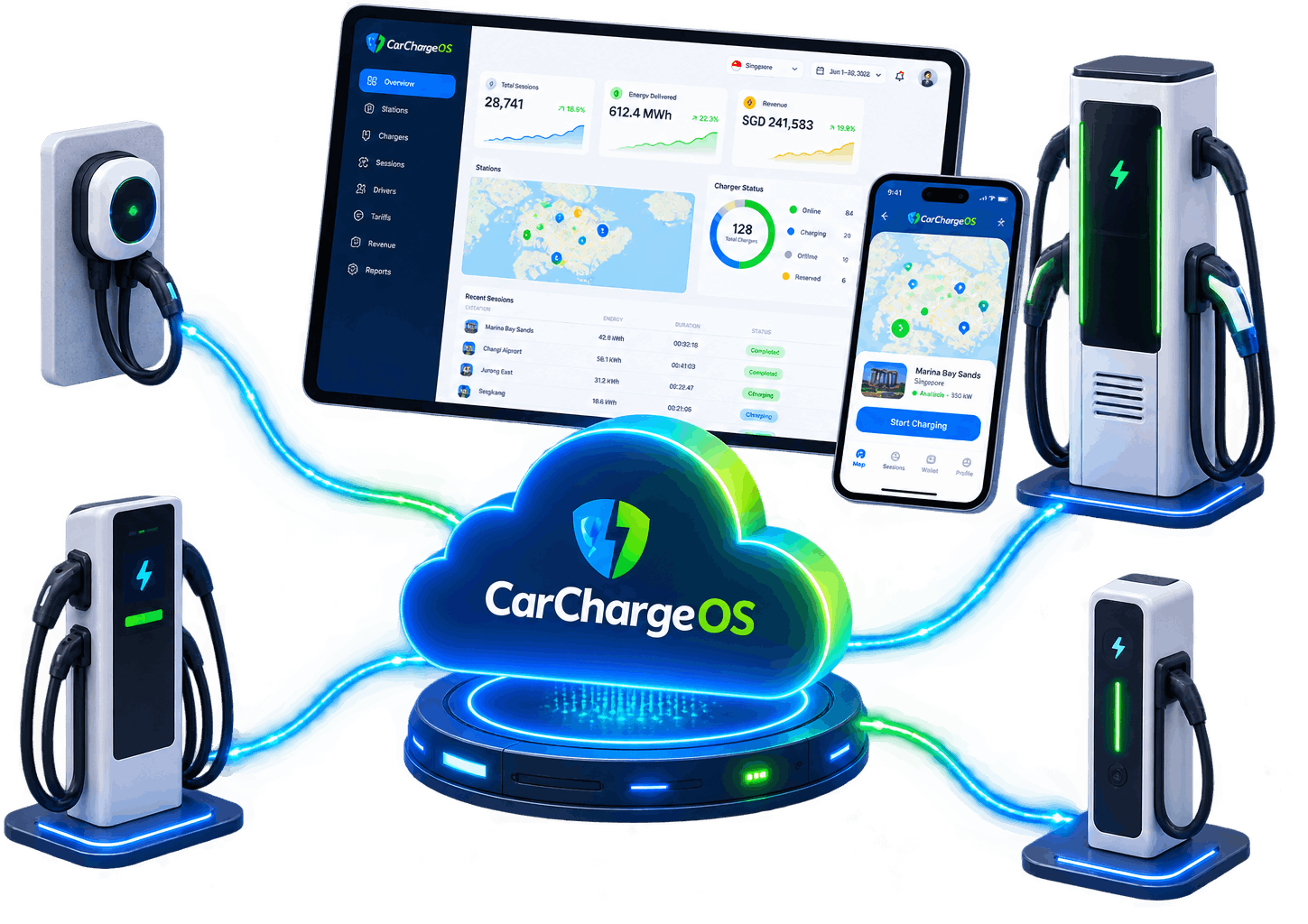
Designed to fit into your technology stack
CarChargeOS does not need to become every system in your organization. Connect charging operations with the systems your business already uses - don't replace your systems, connect them.
08 · SECURITY & COMPLIANCEBuilt for infrastructure your business depends on.
Security, availability and operational resilience are designed into the platform architecture, rather than added after deployment.
Encryption for supported data in transit and at rest.
Role-based access with enterprise identity integration (SAML, OIDC, SSO) and custom roles.
Every administrative and operational action logged at the request level - who, what, when, and the result - filterable and exportable on demand.
Redundant platform services and automated recovery.
Application, infrastructure and charger-level monitoring.
Backup, recovery and configurable deployment / data-residency options.
Where regulation or policy requires it, the entire platform can run inside your own cloud account or an air-gapped on-premise environment, with in-country data residency - the same product and release cadence in every deployment model.
09 · IMPLEMENTATIONFrom concept to charging network in weeks.
A structured implementation process gets your branded charging platform into market quickly while keeping integration and operational risk under control.
Business requirements · charger environment · branding · payment requirements · infrastructure selection · integration scope.
Tenant configuration · tariffs · payment setup · user roles · charger profiles · infrastructure provisioning.
Branded EV owner applications · branded operator experience · APIs · SSO · payment and business-system integrations.
Charger interoperability testing · end-to-end sessions · payment and billing validation · operational and user acceptance testing.
Production deployment · app-store release · charger onboarding · operational handover · training · go-live support.
* Typical timeline for standard Enterprise deployments with supported hardware. Complex migrations, integrations or custom development may require additional time.
10 · BUILD VS. PARTNERBuild your charging business — not another software platform.
Building an EV charging platform internally means maintaining mobile apps, payments, billing, cloud infrastructure, charger protocols, security and continuous product development - before the first customer charges.
| BUILDING INTERNALLY | WITH CARCHARGEOS |
|---|---|
| Build a CSMS | ✓ Production-ready platform |
| Build iOS & Android apps | ✓ Branded apps included |
| Build payment workflows | ✓ Integrated payments |
| Build a billing engine | ✓ Billing & invoicing included |
| Implement OCPP | ✓ Multi-vendor OCPP support |
| Implement roaming | ✓ OCPI-ready |
| Build cloud infrastructure | ✓ Managed deployment |
| Create monitoring & operations | ✓ Operational tooling included |
| Recruit software teams | ✓ CarChargeOS technology team |
| Long development programme | ✓ Target launch: 4–6 weeks* |
* Typical timeline for standard Enterprise deployments. Complex migrations, integrations or custom development may require additional time.
11 · MIGRATIONAlready operating a charging network? Move without starting over.
CarChargeOS supports structured migration from existing charging platforms, helping operators transition chargers and business data while reducing disruption to live charging operations.
Review existing chargers, protocols, integrations and platform architecture.
Define charger, customer, tariff and business-data migration requirements.
Test hardware connectivity, integrations and business workflows.
Move agreed workloads using a controlled migration plan.
Transition production traffic and validate the new environment, with rollback criteria agreed before cut-over.
12 · ILLUSTRATIVE ENGAGEMENTHow an enterprise deployment typically unfolds.
An illustrative engagement based on a representative enterprise deployment pattern. Customer references and detailed results are available on request under NDA.
A regional energy company operating public charging across multiple vendor portals: one system for charger management, another for payments, a third for customer support - with no branded app and manual, spreadsheet-based reconciliation between them.
Existing OCPP chargers were connected to CarChargeOS without hardware replacement. The operator console consolidated monitoring, tariffs, sessions and billing into one view; branded iOS and Android apps launched under the company's own developer account; payments and finance systems were integrated through the platform's APIs.
One live operational view across the network, automated reconciliation on a single ledger, and a customer experience carrying the company's brand end-to-end - with the internal team focused on network growth and site acquisition rather than software maintenance.
13 · ENTERPRISE PACKAGE & NEXT STEPSEverything you need to launch at scale.
Tell us about your market, charging network and business goals.
See the operator console and branded apps against your use cases.
A deployment plan, integration scope and commercial proposal for your network.