
NACS began as Tesla's charging connector design and is now associated with the SAE J3400 standardization effort. It has become an important part of North America's charging landscape, with adoption extending beyond Tesla vehicles. See the U.S. Joint Office J3400 guide.
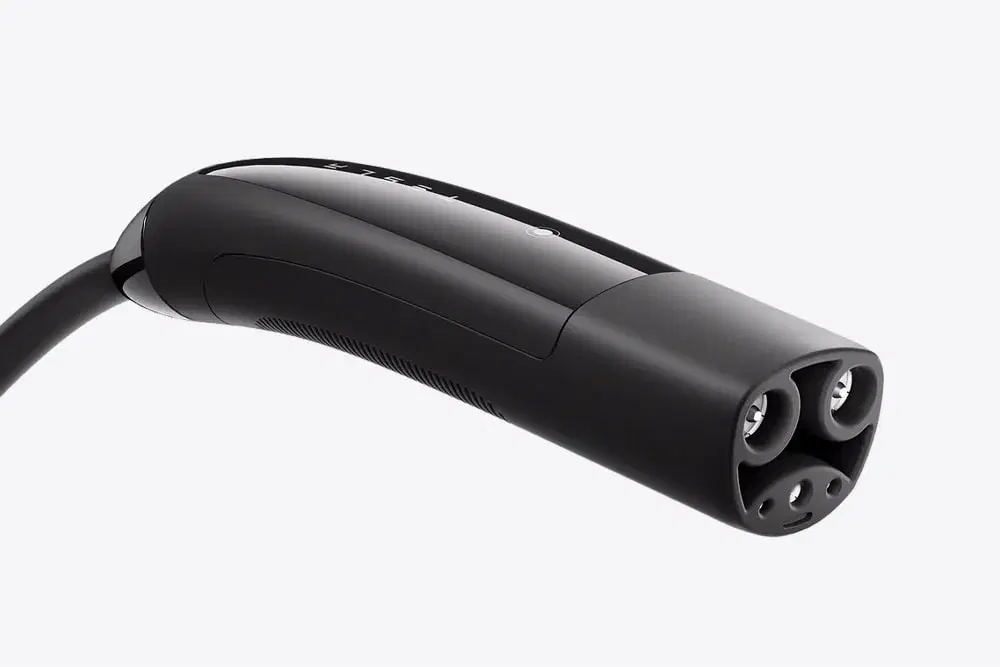
The name is widely expanded as North American Charging Standard. SAE's J3400 document uses North American Charging System. For drivers, the more useful distinction is between the connector standard, the vehicle's supported functions, and access to a particular charging service.
Key characteristics: one interface for AC or DC
NACS uses a compact connector design whose two main power contacts can carry either single-phase AC or DC. They are used in the appropriate mode, not for AC and DC simultaneously. The same connector family can therefore serve AC destination charging and DC fast charging. See the SAE J3400 scope.
That does not mean every NACS charger provides both modes. An AC charging unit remains an AC unit; a DC fast charger supplies DC. The equipment and vehicle specifications determine what a particular connection can do.
Where is NACS used?
Its principal market is North America. Adoption is expanding, but operators should still plan for a mix of NACS, CCS1, and J1772-equipped vehicles rather than assuming the transition is complete.
As of this article's September 2026 review, Tesla describes both non-Tesla vehicles with native NACS inlets and supported vehicles using NACS DC adapters. It also distinguishes Supercharger locations by vehicle access. That is a reason to check live compatibility information rather than rely on a static list of brands. See Tesla's guide to Supercharging other EVs.
Does a NACS connector guarantee Supercharger access?
No. Connector compatibility and network access are separate checks. Drivers should confirm their exact vehicle in the network's app or compatibility guide and verify the intended location. Where an adapter is needed, it must meet the vehicle manufacturer's and charging network's requirements.
An adapter for AC destination charging and an adapter for DC fast charging perform different jobs. Do not assume one can replace the other, or that an adapter works in both directions. Likewise, a matching connector does not establish that the charger's voltage range and the vehicle's charging system are a suitable match.
What operators should test during a transition
Start with local demand: which vehicles use the site today, and which confirmed fleet purchases will arrive next? Use that evidence to decide whether to add NACS, retain existing connectors, or deploy mixed equipment.
Recommended operational checks include:
- Cable reach across different vehicle inlet positions and parking layouts.
- Clear labeling of NACS AC versus NACS DC services.
- Successful sessions with the supported vehicle and adapter combinations.
- Accurate availability, authorization, and session records across connector types.
For a white-label CSMS project using CarChargeOS, make these part of the proposed charger integration review. Test what drivers see and what support staff can diagnose when a session fails. A software integration should not be treated as proof of universal vehicle or charging-network compatibility.
Practical takeaway
NACS is a significant North American charging interface, but its name is not a promise that every car can use every station. Match the connector, charging mode, vehicle capability, and network access, then test the combinations your site intends to support.
Related: CCS1 and CCS2 and Type 1 / J1772 AC charging.