
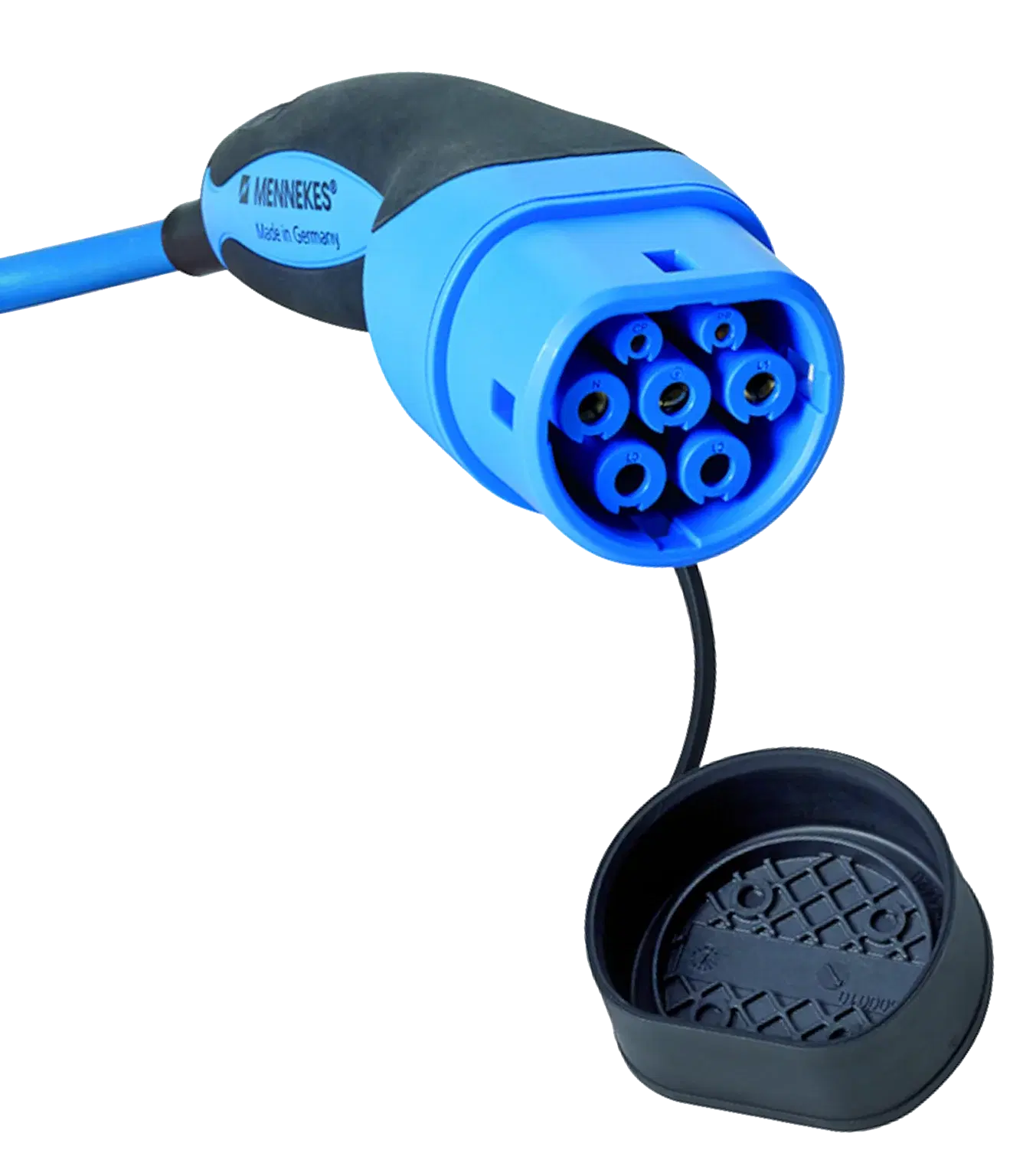
Type 2 is the established AC charging interface across Europe, including the UK. Often called the Mennekes connector, it is associated with IEC 62196-2. It is a useful starting point for understanding charging at homes, offices, hotels, and public parking facilities. See Mennekes' vehicle-inlet overview.
What makes Type 2 different?
The Type 2 interface has seven contact positions: power connections, protective earth, and two signaling contacts. It supports single-phase or three-phase AC, depending on the equipment and vehicle. IEC 62196-2 defines AC charging accessories; the standard's scope should not be mistaken for the rating of every product built to it. See the IEC 62196-2 overview.
Three-phase support is particularly useful at sites with a suitable electrical supply, but the vehicle must also support it. A Type 2 inlet does not, by itself, tell you the car's onboard charging capacity.
How much power can a Type 2 charger deliver?
Common equipment configurations include approximately 7.4 kW on single-phase AC, and 11 kW or 22 kW on three-phase AC. These are familiar installation ratings, not a universal minimum or maximum for the connector family. Manufacturer product ranges illustrate these configurations. See the Mennekes installation manual.
For example, a car whose onboard charger accepts up to 11 kW will not take 22 kW AC simply because the wallbox is rated for it. The cable rating and site power allocation can impose further limits. Publish the available charging power clearly, without presenting it as a guaranteed rate for every visitor.
Is Type 2 the same as CCS2?
No. Type 2 is the AC interface discussed here; CCS2 adds dedicated DC contacts below it. A compatible CCS2 vehicle inlet accepts a Type 2 AC plug, but a plain Type 2-only inlet cannot accept the larger CCS2 DC plug. See the CharIN CCS implementation guide.
For drivers, this means that a familiar upper connector shape is not enough to confirm DC charging capability. Check whether the vehicle inlet includes the lower DC section and whether the car supports that charging service.
Compatibility and operations at destination sites
Decide early whether the charger will have a permanently attached cable or a socket that requires drivers to bring a suitable cable. Communicate that choice before arrival, especially at hotels and visitor parking.
For a site with several bays, recommended planning steps are:
- Estimate how much energy visitors need during their typical stay.
- Confirm available supply capacity and how single-phase vehicles affect phase loading.
- Test the planned power-sharing behavior with a realistic mix of vehicles.
- Explain access rules, charging prices, and any parking or idle charges clearly.
When evaluating a white-label CSMS such as CarChargeOS, ask how the proposed charger integration will represent connector availability and apply the project's charging controls. Verify the complete setup under load; software settings alone do not establish that the electrical installation can support the intended demand.
Practical takeaway
Type 2 is well suited to AC charging where vehicles remain parked long enough to replenish their batteries. Match power to dwell time and vehicle capability, label cable requirements, and keep Type 2 AC distinct from CCS2 DC in customer-facing information.
Related: Charging standards overview and CCS1 and CCS2 explained.