
Six major connector families provide a useful starting point: Type 1, Type 2, CCS, NACS, GB/T, and CHAdeMO. However, six is not an exhaustive count of every EV charging standard worldwide. The answer changes depending on whether you count connector variants, communication protocols, or specialized charging systems.
For drivers, the immediate question is whether a charger works with their vehicle. For charging operators, the challenge is choosing equipment that serves the local vehicle mix and can be managed reliably.
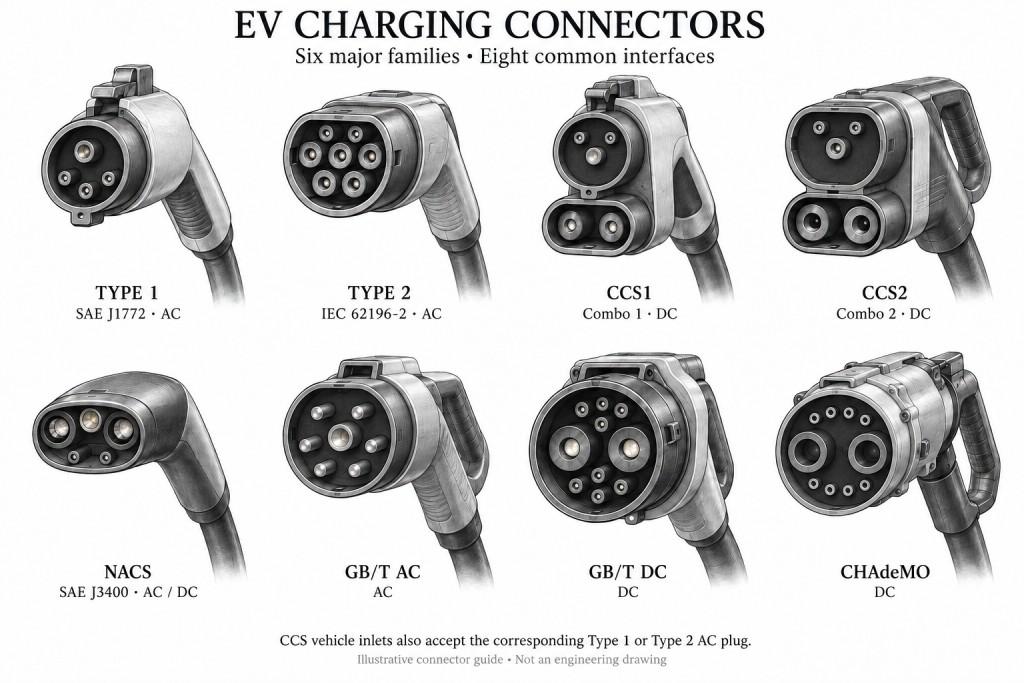
The six major connector families
| Family | AC/DC capability | Main regional association | What to recognize |
|---|---|---|---|
| Type 1 / SAE J1772 | Single-phase AC | North America and Japan | Five-contact AC connector |
| Type 2 / IEC 62196-2 | Single- or three-phase AC | Europe, including the UK | Seven-contact AC connector, often called Mennekes |
| CCS / CCS1 and CCS2 | AC and DC through a combined vehicle inlet, using different plugs | CCS1: North America; CCS2: Europe and other markets | Two large DC contacts below the Type 1 or Type 2 interface |
| NACS / SAE J3400 | Single-phase AC or DC | North America | Compact interface that shares its main power contacts between AC and DC |
| GB/T | Separate AC and DC interfaces | Mainland China | A family of charging standards, not one universal plug |
| CHAdeMO | DC | Japan, with installations in other markets | Dedicated DC interface; AC charging uses a separate inlet |
These are regional patterns, not guarantees for individual vehicles. The same model can have different charging hardware in different markets. The regional overview is supported by Yazaki's charging-inlet portfolio, CharIN's CCS guide, and the SAE J3400 overview.
Why the total is not simply six
This list groups CCS1 and CCS2 together, and groups GB/T AC and DC together. Counting each interface separately would produce a different total. It also focuses on common conductive charging for passenger vehicles, rather than covering every heavy-duty, wireless, or legacy system.
“Charging standard” can also refer to communication. OCPP, for example, describes communication between charging stations and a charging station management system, or CSMS. It does not describe the plug that connects to the car. See how Open Charge Alliance explains OCPP's role, or read our own What Is OCPP? guide.
AC, DC, and charging speed
With AC charging, the vehicle's onboard charger converts alternating current into the direct current stored in the battery. With DC charging, that conversion happens outside the vehicle. Actual charging speed depends on the car, charging equipment, battery conditions, and available site power - not just the connector name. See the U.S. Department of Energy charging guide.
That is why a connector label should always be accompanied by the charger's power rating and the vehicle's supported charging specifications.
What interoperability means in practice
Before planning a journey or buying equipment, check three things:
- Physical and electrical compatibility: the inlet, plug, AC/DC mode, and supported voltage/current must match.
- Successful communication: the vehicle and charger must support a compatible charging implementation.
- Service access: the driver must be able to authorize and pay for the session where required.
A plug that fits is only part of the answer. Adapters need to be approved for the specific vehicle and charging use; they do not automatically provide access to every network.
For an operator evaluating a white-label CSMS such as CarChargeOS, turn these checks into procurement and commissioning requirements. Request accurate connector labels, clear availability information, and tests that follow a session from authorization to its final record. A CSMS cannot make incompatible vehicle and charger hardware work together.
Practical takeaway
Use six major families as a clear introduction, then check the exact interface and vehicle specification. For site planning, start with the vehicles you need to serve and their parking duration before deciding which connector mix to install.
Continue with the detailed guides: Type 1, Type 2, CCS, NACS, and GB/T versus CHAdeMO.